Tool we made

Payment and document matching platform for small businesses

Description

We designed and built CraftedBills, a local-first product that helps small businesses reconcile payments with source documents before the month reaches accounting.

Product

CraftedBills — payment and document reconciliation

Year

2026

Scope

Product strategy, UX/UI, native macOS and iOS product, KSeF, local OCR, matching engine, privacy and MVP

Live product

CraftedBills

Open live ↗
What we built

One dependable workspace between a business payment and the accountant who needs its document.

Small businesses rarely lack invoices because nobody cares. The problem is that payments, KSeF records, e-mail attachments, downloads and scans live in different places, while accounting needs a complete and explainable month. CraftedBills starts with what actually left the account and makes every missing link visible.

We shaped the product as a native, local-first workflow for business owners, finance assistants and accountants. It collects source documents without pretending that KSeF contains the whole picture, suggests payment-document relationships, keeps uncertain cases visible and turns verified decisions into an orderly month-end handoff.

01

Turning month-end document chasing into a visible process

The original process was fragmented across banking, KSeF, local folders and memory. A payment could be real and correctly booked by the bank while its invoice was still waiting in an inbox, available only as a foreign PDF or missing altogether. The resulting spreadsheet and e-mail exchange identified problems late, when both the business and accounting were under time pressure.

CraftedBills makes completeness the main operating view. A monthly dashboard shows payments requiring documents, suggested pairs, confirmed items and unresolved exceptions, so the next action is visible before an accountant has to ask for it.

  • A payment-first month-end workflow
  • Clear completeness and missing-document states
  • One queue for decisions and exceptions
  • Shared language for the business and accounting

Business result: owners see what is still missing while there is time to recover it, and accounting receives fewer incomplete or unexplained submissions.
02

A stable payment record as the starting point

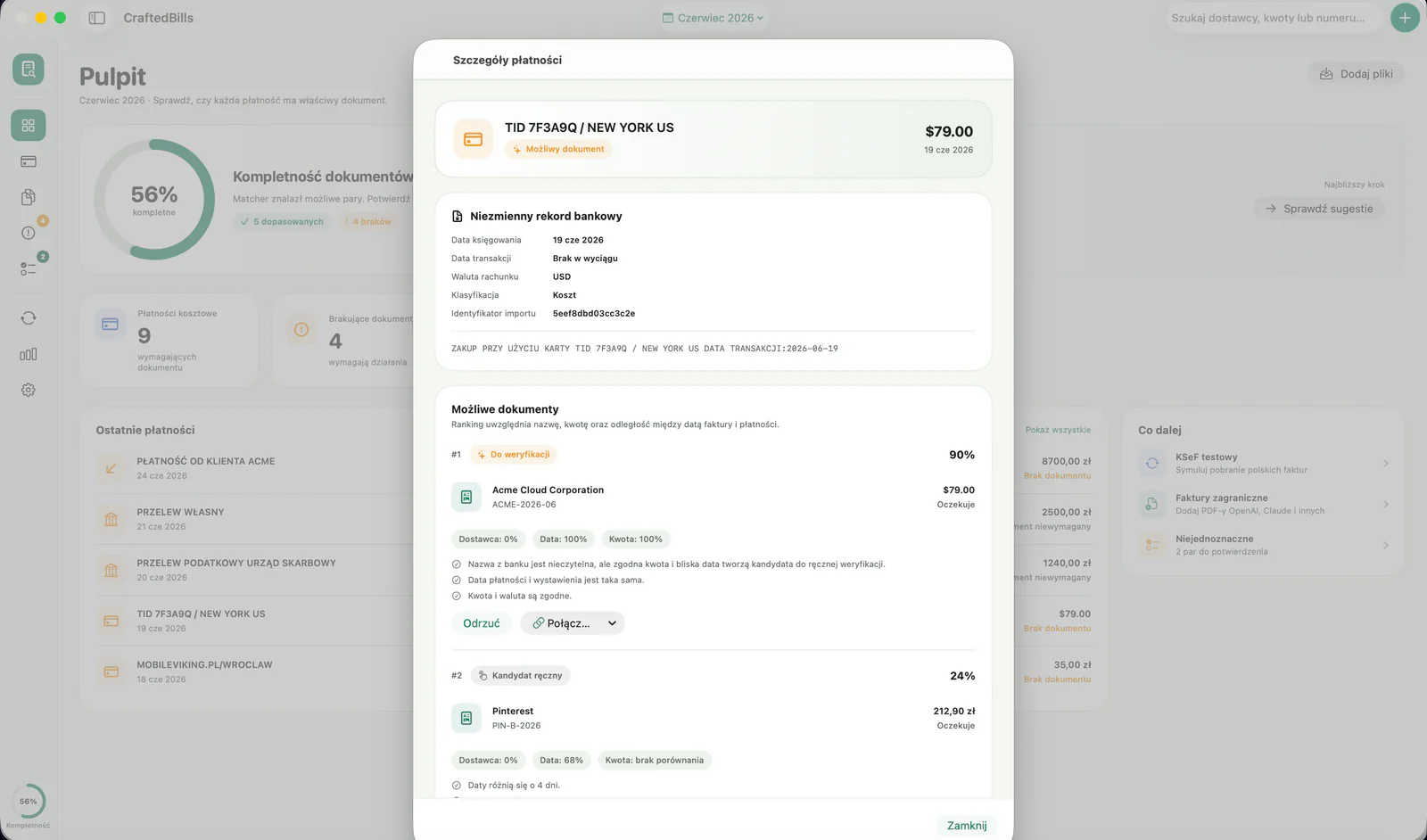
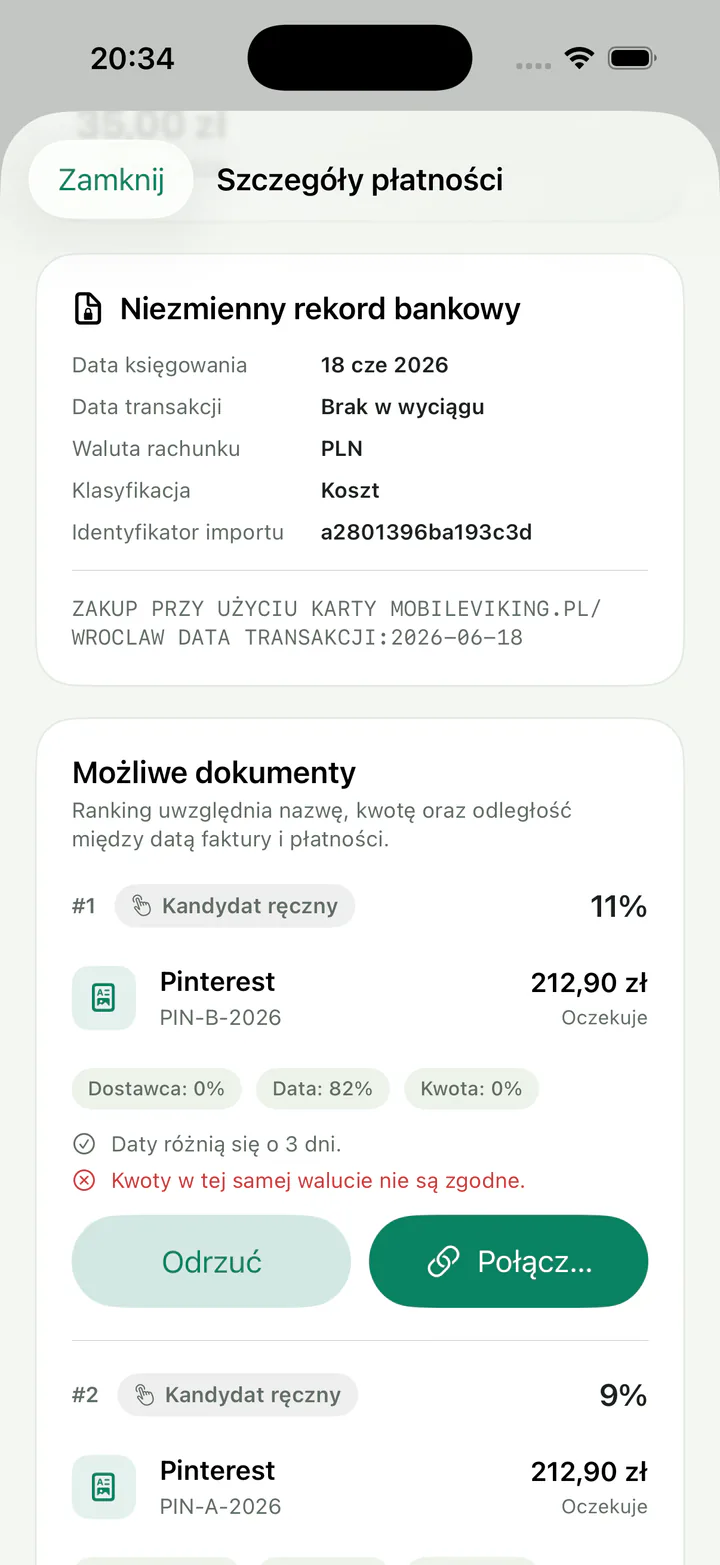
Imported bank activity becomes an immutable source record rather than a row that silently changes during reconciliation. The product preserves booking data, account currency, original descriptions and import identifiers, then classifies which transactions require a cost document and which belong to another flow.

Duplicate-aware imports allow another statement to be added without rebuilding the month. Each payment keeps its own status, candidate documents and decision history, giving users a reliable route back to the original evidence.

  • Immutable imported payment records
  • Duplicate-aware incremental imports
  • Cost, non-cost and excluded transaction states
  • Traceable source data behind every decision

Business result: reconciliation rests on a consistent source of truth instead of an editable spreadsheet whose history and exceptions are difficult to audit.

Payment and document matching platform for small businesses — A stable payment record as the starting point 1
03

KSeF, foreign invoices, PDFs and scans in one document model

Polish structured invoices are only one part of a real company's document set. CraftedBills combines supported KSeF records with local PDFs and scans, while preserving each original XML or file. The current MVP validates KSeF through the test environment before production access is enabled.

Supported scans can be read locally with Apple Vision OCR in Polish or English. Foreign supplier documents remain first-class records, including their currency, dates, amount and vendor, and incomplete recognition can be corrected without changing the source file.

  • KSeF test integration with local XML storage
  • Local PDFs and foreign supplier invoices
  • On-device Polish and English OCR
  • Original source files preserved unchanged

Business result: the month is assembled from all real document sources, reducing the blind spots created by treating KSeF as a complete archive of company costs.

04

Explainable matching instead of a mysterious score

The matching engine ranks possible documents using vendor signals, amount, currency and distance between invoice and payment dates. A suggestion shows both positive and negative evidence, including incompatible amounts or weak vendor recognition, before the user accepts or rejects it.

The workflow also supports practical accounting relationships: several payments can be grouped against one invoice and one transfer can cover several invoices. For foreign-currency cases, original bank amounts are preferred; where they are unavailable, a historical NBP rate can be shown only as an estimate rather than presented as the card exchange rate.

  • Visible signals behind every candidate
  • Human confirmation for uncertain relationships
  • Many-to-one and one-to-many matching
  • Multi-currency comparison with clearly labelled estimates

Business result: users can defend and correct a match because they understand its evidence, while ambiguous cases remain reviewable instead of being hidden behind automation.

05

Missing documents, exceptions and a clean accountant handoff

A missing document is a workflow state, not a silent failure. Users can separate items still being collected from intentional exclusions, ambiguous candidates and records that require a note. The product keeps those differences visible throughout the month.

Once reviewed, CraftedBills prepares a month package with payments, documents, confirmed relationships, decisions and clearly described exceptions. The accountant receives context together with the files rather than another folder whose completeness must be reconstructed from scratch.

  • Dedicated missing-document and exception queues
  • Notes attached to unusual decisions
  • Verified month status before export
  • Structured handoff with files and context

Business result: accounting spends less time identifying gaps and asking repeated questions, while the business retains an understandable record of what was delivered and why.

Payment and document matching platform for small businesses — Missing documents, exceptions and a clean accountant handoff 1
Payment and document matching platform for small businesses — Missing documents, exceptions and a clean accountant handoff 2
06

A local-first privacy model for financial documents

Core importing, OCR, matching, verification and reporting are designed to run on the user's Apple devices. Current documents remain local, integration credentials stay in Keychain and online connections are limited to deliberately enabled sources. The deterministic workflow remains useful without cloud AI.

This architecture reduces unnecessary movement of invoices and bank records while preserving practical integrations. It also makes privacy boundaries part of the product model: original files, credentials, optional network services and future AI features have separate responsibilities rather than sharing one opaque data pipeline.

  • On-device core workflow
  • Integration secrets stored in Keychain
  • Purpose-limited network connections
  • Optional AI rather than a dependency for core decisions

Business result: sensitive financial work can remain useful and understandable with less cloud exposure, without giving up the integrations required to close the month.

07

Native interfaces for desk work and quick review

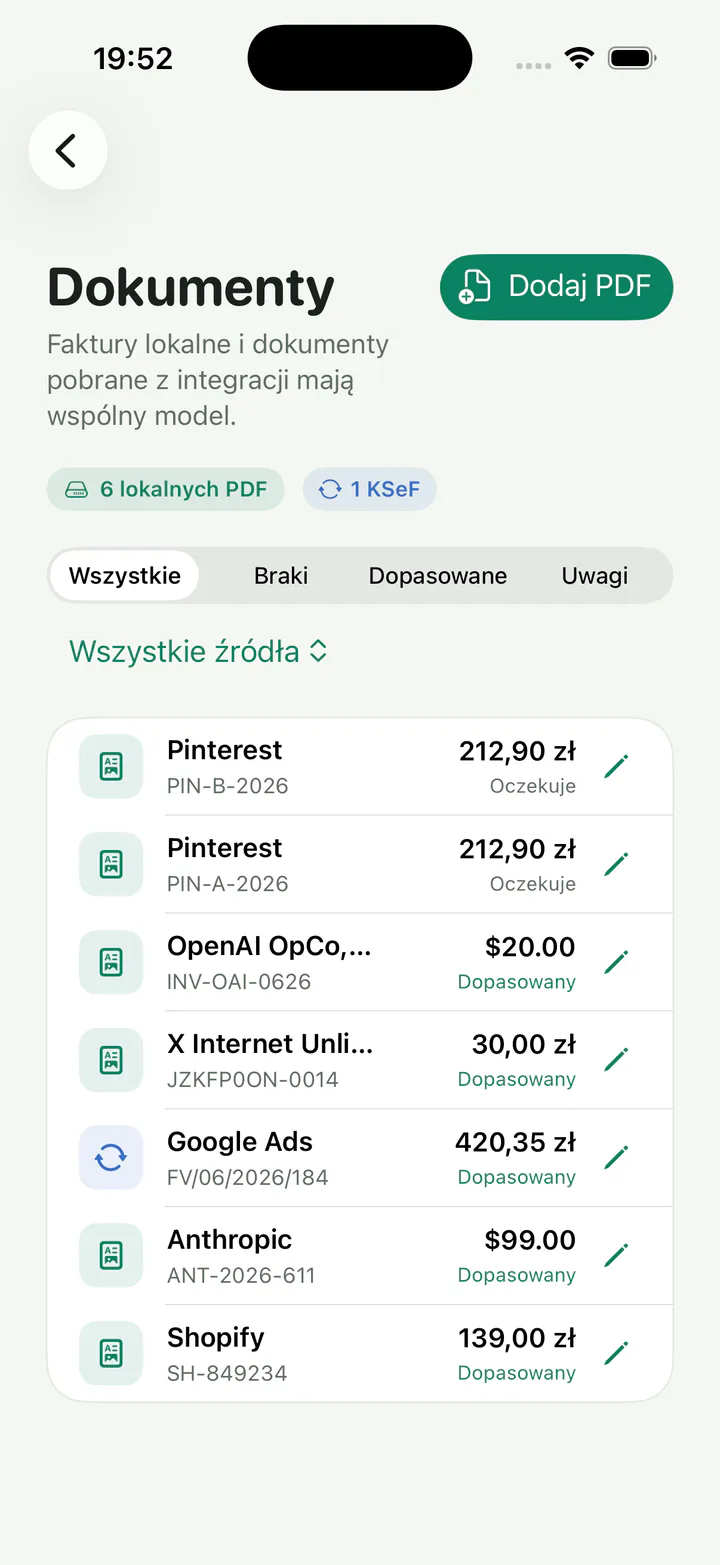
The macOS experience supports detailed reconciliation with a dashboard, source lists and side-by-side decision context. An adaptive iOS interface carries the same document and payment model into focused mobile review, using native navigation and controls instead of shrinking a desktop website.

The visual system makes status carry meaning across platforms: confirmed relationships, missing documents, warnings and manual candidates remain distinct. Dense financial information is grouped into calm, scannable panels so users can understand both the monthly overview and the evidence behind one payment.

  • Native macOS product architecture
  • Adaptive iOS product interface
  • Consistent status and exception language
  • Accessible hierarchy for dense financial records

Business result: users can perform complex month-end work at a desk and review focused cases on mobile without learning two unrelated products.

08

MVP validation before wider financial-system access

The first release path uses demonstration data and controlled integrations to validate the complete workflow: import, document collection, OCR, candidate ranking, manual correction, grouped matches, missing-item handling and accountant export. Test data also covers currencies, duplicate imports, weak matches and incomplete scans.

Production KSeF access and broader distribution remain gated until integration behavior, security and recovery paths are fully validated. Product feedback is collected around time saved, unresolved cases, matching usefulness and the clarity of the exported month rather than only interface preference.

  • End-to-end workflow testing with demonstration data
  • Edge cases for imports, OCR, matching and currencies
  • Controlled KSeF test environment
  • Measured pilot before production expansion

Business result: product scope expands only after the month-end workflow and sensitive integrations are proven, reducing operational and data risk at launch.

Build with DGBA

Need a platform built around your offer and operations?

We connect strategy, UX/UI, development, integrations and launch in one delivery team.

Start a project