Tool we made

AI chatbot platform for companies across industries

Description

We designed a modular AI chatbot platform that combines approved company knowledge, natural-language conversation and controlled actions in business systems for companies across industries.

Product

DGBA AI Chatbot — cross-industry agent platform

Year

2026

Scope

Product strategy, conversational UX, ElevenAgents, RAG, integrations, guardrails, analytics and pilot

Live implementation

MIA Preserve AI assistant

Open live ↗
What we built

A conversation is valuable when it reaches a real business outcome.

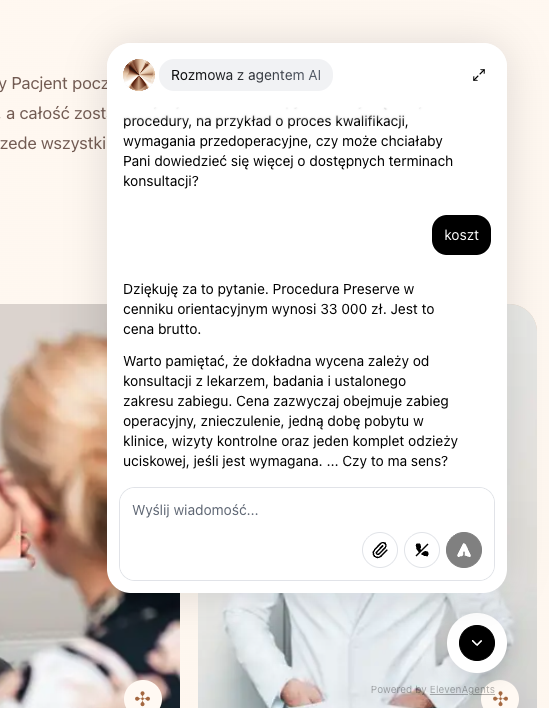
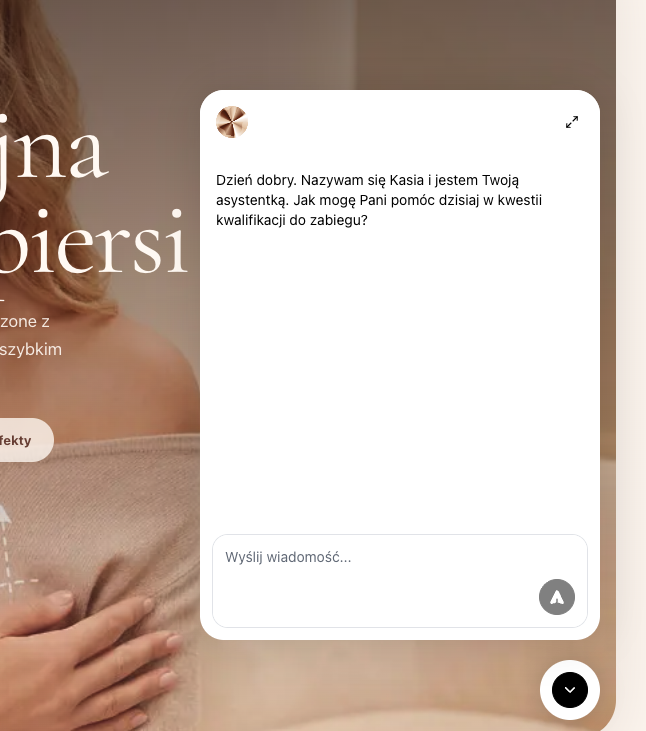
We designed the DGBA AI Chatbot as more than a floating FAQ. It understands a visitor's intent, uses approved company knowledge and can move the conversation toward an answer, qualified inquiry, booking, payment or deliberate handoff to a human.

The same core can serve many industries because the product separates reusable agent architecture from client-specific knowledge, workflows, risk boundaries and integrations. A clinic needs different rules than an online store, but both benefit from an immediate response and a clear next action.

01

Designing for an outcome, not just an answer

Visitors often arrive with high intent but leave because a static page cannot respond to their individual situation. The chatbot asks the minimum useful follow-up questions, explains the relevant option and guides the person to the next step while their intent is still active.

Every conversation path has a defined result: a resolved question, structured lead, confirmed booking, secure payment path or handoff with context. This keeps the product tied to business operations rather than vanity metrics such as message volume alone.

  • Immediate natural-language response
  • Context retained across multiple turns
  • Questions adapted to previous answers
  • A defined success or escalation state for each path

Business result: more website visits can become useful conversations, and fewer prospective customers wait until the next working day for a basic answer.
02

One modular platform adapted to every industry

The reusable layer handles conversation, knowledge retrieval, workflows, tools, analytics and handoff. During discovery we configure the vocabulary, tone, permitted actions and success criteria around the client's actual operating model.

Healthcare can use the agent as an administrative reception layer, legal and accounting firms can qualify matters without providing binding advice, property and automotive businesses can collect preferences and arrange appointments, while e-commerce can support product choice, order questions and tickets.

  • Clinics, dentistry, beauty and wellness
  • Accounting, legal and advisory services
  • Education, recruitment, property and automotive
  • E-commerce, support, local services and B2B sales

Business result: companies receive an industry-specific workflow without funding a completely separate conversational platform from the beginning.

AI chatbot platform for companies across industries — One modular platform adapted to every industry 1
AI chatbot platform for companies across industries — One modular platform adapted to every industry 2
03

Approved knowledge with ownership and retrieval rules

We build the knowledge layer from service descriptions, pricing rules, specialist profiles, locations, procedures, FAQs, internal instructions and approved web or document sources. Retrieval-augmented generation selects the fragments relevant to the current question instead of asking the model to improvise from general memory.

The knowledge base has an owner, review process and update schedule. Conflicting or outdated content is resolved before launch, and the agent is instructed to acknowledge a gap rather than invent a confident answer when an approved source is missing.

  • Structured company sources and RAG
  • Source approval before publication
  • Ownership and scheduled knowledge updates
  • Clear fallback when verified information is unavailable

Business result: sales, support and the website can use one answer standard while the company retains control over what the agent is allowed to communicate.

04

Qualification and recommendation without a rigid form

Instead of presenting every visitor with the same long form, the agent asks only for information required by the selected scenario. It can clarify the goal, service type, location, timing, urgency, budget range or preferred contact method and explain why a question matters.

The result can be written to a CRM as a structured lead with category, source, priority and conversation summary. In regulated sectors the recommendation remains administrative: for example, choosing a consultation type without diagnosing, interpreting results or replacing a licensed specialist.

  • Adaptive lead-intake questions
  • Service, department or specialist routing
  • Structured CRM records and summaries
  • Explicit boundaries for regulated decisions

Business result: teams receive more complete inquiries and spend less time reconstructing the customer's need before the first human contact.

05

Bookings, payments and repeatable customer actions

When the client's systems expose suitable APIs, the chatbot can retrieve current availability, offer matching slots, collect required information and confirm a booking only after the source system reports success. The same pattern supports changes, cancellations, waiting lists and online or in-person appointments.

For deposits or purchases, the agent sends a secure checkout link rather than collecting card details in the conversation. E-mail and SMS tools can deliver confirmation, preparation instructions or a conversation summary after the underlying operation succeeds.

  • Real-time availability and confirmed reservations
  • Changes, cancellations and waiting lists
  • Secure payment or deposit links
  • E-mail and SMS confirmations triggered by system status

Business result: a visitor can complete a simple process immediately, including outside office hours, without creating another manual task for the team.

06

A controlled integration layer between AI and operations

The agent does not receive unrestricted access to the client's systems. A DGBA integration layer authenticates requests, validates data and exposes narrow business actions for CRM, calendars, industry software, messaging and payments.

Retries, idempotency and operation logs prevent duplicate leads or bookings and make failures traceable. If an API is unavailable, the safe fallback is a structured request for human confirmation; we do not call that an automatic booking until the source system has confirmed it.

  • Server-side secrets and authenticated tools
  • Schema validation and limited operation scope
  • Retry, idempotency and audit records
  • Honest fallback when a client system has no usable API

Business result: automation can reduce data re-entry without giving a language model uncontrolled authority over critical business systems.

07

Human handoff that preserves the conversation

Escalation is a designed outcome, not evidence that the chatbot failed. It activates when the user asks for a person, the question exceeds approved knowledge, a system operation fails, identity cannot be confirmed or the matter requires professional responsibility.

The agent can create a ticket, start live chat, arrange a callback or route a summary to the correct department. The person taking over receives intent, collected details, attempted actions and the point of failure instead of asking the customer to repeat the whole story.

  • User-requested and policy-triggered escalation
  • Tickets, callbacks, live chat or department routing
  • Full context and structured summary for the team
  • No false confirmation after timeout or integration error

Business result: automation handles repeatable work while specialists enter the process with enough context to resolve exceptions efficiently.

08

Privacy, guardrails and high-stakes boundaries

Users are told that they are speaking with AI, and data collection is limited to the purpose of the selected workflow. Keys remain server-side, domains and tools are authorized, webhooks are validated, and retention, access and deletion procedures are agreed before launch.

Healthcare, legal and financial deployments receive stricter rules. The agent can support reception and administration but does not diagnose, interpret results, recommend treatment or provide binding professional decisions. Sensitive-data use requires a separate assessment of legal basis, processors, transfers and retention.

  • Transparent AI disclosure and data minimization
  • Server-side credentials and webhook validation
  • Conversation retention and access procedures
  • Explicit prohibition of unsupported professional decisions

Business result: useful automation operates inside a documented responsibility boundary instead of quietly expanding into decisions that belong to people.

09

Discovery, testing, pilot and measurable improvement

Implementation starts with business goals, common intents, source systems, data risk and baseline metrics. We then map conversation paths, prepare knowledge, build the interface and integration layer, and test successful flows alongside missing information, contradictory input, API errors and attempts to leave the permitted scope.

A limited pilot gives the team real transcripts and outcome data before scaling traffic. We measure response time, after-hours conversations, completed cases, escalations, leads, bookings, tool errors, recovered team time and cost per completed outcome, then improve knowledge and workflows from evidence.

  • Discovery and baseline KPI definition
  • Scenario, tool and adversarial testing
  • Controlled pilot with conversation review
  • Optimization based on outcomes, errors and team time

Business result: the rollout can prove where the agent creates value before the company expands integrations, traffic or transactional authority.

Build with DGBA

Need a platform built around your offer and operations?

We connect strategy, UX/UI, development, integrations and launch in one delivery team.

Start a project